How civil society can turn marketing into behavioral science for good


What happens when an anti-consumerist mindset meets modern digital marketing?
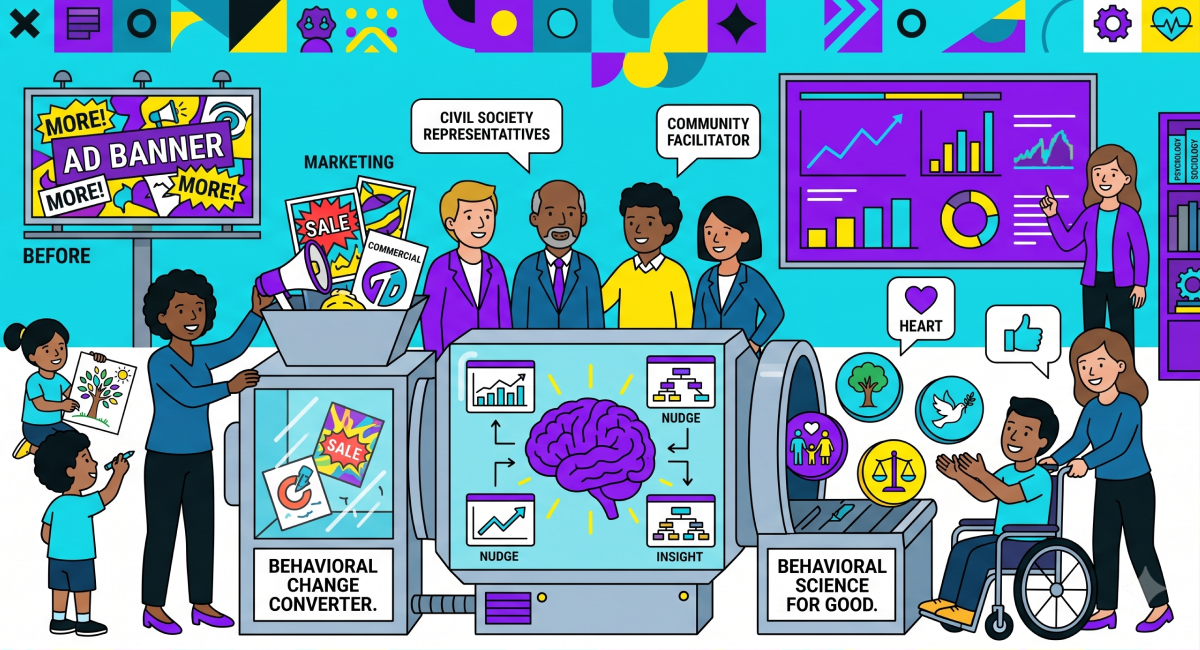
For most NGOs, civil society organizations (CSOs), and social enterprises, the word "marketing" triggers immediate skepticism. But inside the social economy, true marketing isn’t about manipulating people into buying things they don’t need; it is a branch of behavioral science. It is the structured study of what moves human beings to make smart, compassionate choices that make the world a better place—and how to channel that behavior into supporting the organizations that actually matter.
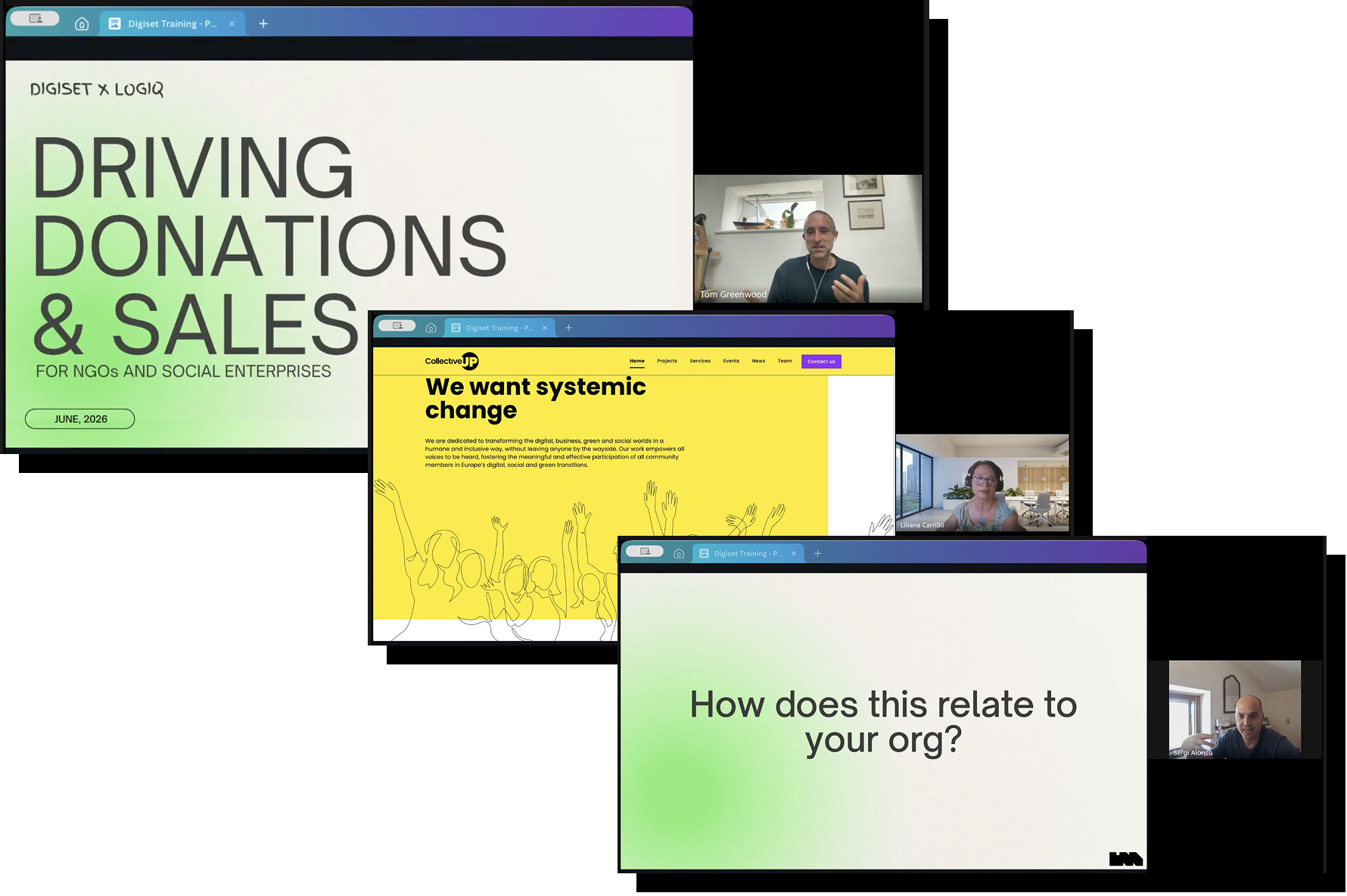
In our latest DIGISET masterclass, CollectiveUP hosted global media strategist and powerhouse innovator Tom Greenwood (whose campaigns have generated over 37 million organic views across platforms like the BBC, Al Jazeera, and The Guardian). Together with leaders from across the European social economy ecosystem, we pulled back the curtain on why traditional NGO communications are failing, and how to build compelling offerings that drive real engagement, structural trust, and sustainable revenue.
Missed this masterclass? We got you covered! Watch the recording here.
Here are the definitive takeaways every social purpose organization needs to implement to escape the "tech jungle" and command mainstream attention.
1. Dismantling the "Second wall" of the echo chamber
Many social purpose organizations struggle with a structural disadvantage. We look at our data, our target metrics, and our funding requirements, and we immediately default to what Tom Greenwood calls "lousy NGO copywriting". We regurgitate overly complex, academic, proposal-style language directly onto our homepages.
This creates a dual-layer barrier for our audiences:
- The Algorithmic Wall: The default platform filters that trap specialized social ideas inside narrow echo chambers.
- The Penetration Wall: The thick, impenetrable layer of technical jargon that drives ordinary human beings away the moment they land on our websites.
To break through this second wall, Greenwood advises non-experts to return to the timeless communication rules laid out by figures like George Orwell and advertising pioneer David Ogilvy:
- Never use an over-proliferation of technical jargon or acronyms when a simple word can convey the point.
- Avoid cliches and buzzwords that mask the human element of your mission.
- Choose short, impactful words over long, multi-syllabic terms.
- Keep your message as brief and value-focused as humanly possible.
As Ogilvy famously noted, using dense jargon is simply the hallmark of a pretentious writer. If you want your audience to put their hand in their pocket and donate, they have to understand your value within seconds.
2. Shift the paradigm: Lead with the "Why," not the "What"
People do not pay or donate to buy a product or support an abstract mission statement; people pay to solve deep, structural problems. To secure support, an organization must prove that it fundamentally understands the exact pain points of its audience. When a visitor feels that you understand their problem on a personal, emotional level, they instinctively trust you to have a viable solution.
During the webinar, we looked at a live case study with the European Democratic Education Community (EUDEC), an organization focused on advocating for student-directed learning systems.
The formula for the "Why":
Instead of over-explaining the administrative mechanics, EUDEC’s messaging pivots to the emotional core: cultivating happiness, emotional intelligence, and self-confidence in children.
However, emotional framing must be paired with evidence-based validation. Parents naturally worry about the future: job security, rates of employment, and societal integration. To neutralize those fears, organizations must explicitly showcase long-term data—such as tracking graduates from democratic schools over 30 years to prove they lead highly successful, well-adapted professional lives.
3. The empathy funnel: From social content to website continuity
If your digital strategy treats social media as a mere broadcasting machine, you are leaking engagement. Social media acts as the wide top of your marketing funnel. Its primary goal is to capture broad interest and spark a micro-moment of curiosity.
Once a user clicks through to your website, their core objective is to judge whether staying there is a good use of their time. Most users abandon a website in under a minute. To lock them in, there must be strict narrative continuity between the vibe they experienced on social platforms and the landing page experience.
Building an Effective Digital Journey:
- The Hero Section: Lead with a powerful, unmistakable mission statement that directly targets the audience's primary pain point.
- The Scroll Experience: As they move down, provide an inspiring macro-pitch regarding the world you are actively building.
- The Deep Dive Options: Only after hooking them should you offer deeper navigation tracks—such as detailed case studies, your formalized theory of change, or white papers for institutional backers.
4. One size fits none: Navigating multi-audience segmentation
What happens when your organization is forced to speak to completely different audiences simultaneously?
This is a classic hurdle highlighted by Sergi Alonso from the Time Banks network, which simultaneously coordinates with everyday local users, local community administrators, and public government officials. Trying to bundle all of these profiles into a single, mixed digital broadcast creates a confusing mess.
The golden rule here is audience segmentation across isolated channels.
- Use broad public channels (like social media profiles) to project a unifying, high-vibe emotional message that everyone can get behind: for instance, combating the modern epidemic of loneliness and building resilient neighborhoods. This messaging wins public support without alienating formal stakeholders. If a politician or public administrator sees an active, joyful community response online, it serves as organic proof of validation.
- Move technical, operational, and administrative communications into direct, private channels (such as dedicated newsletters, WhatsApp groups, or portals) where specialized stakeholders can talk mechanics without clogging up public channels.
The power of tangible experiences:
The Time Banks network discovered that organizing real-world engagement events—such as community improv workshops—was vastly more effective for driving donations than a purely digital marketing push. Why? Because human beings are naturally wired to give back when they have just experienced a tangible, positive, and valuable real-world connection.
5. Scaling up the social ecconomy: Decoupling and tech sovereignty
At CollectiveUP, we are undergoing our own internal alignment to move into our next chapter. Our evolving mission is anchored on two primary pillars: democratizing democracy and democratizing technology.
During the session, Tom Greenwood pointed out a major macro-economic shift that represents a highly lucrative, sustainable business opportunity for social enterprises. In the wake of intense geopolitical volatility and sudden software pipeline constraints, there is an urgent, growing demand across both the European private sector and regional governments to decouple from American Big Tech dependencies. This shift toward technological sovereignty is where civic tech can step up to provide secure, cost-effective, and mission-aligned alternatives.
To scale our consultancy model and position ourselves effectively without creating personal bottlenecks, CollectiveUP is focusing on advanced operational scaling:
- Hiring for Trust and Synergies: Moving from an individual model to an agency framework requires finding capable individuals through organic, personal relationships and testing them with practical, hands-on problem-solving assignments.
- Understanding the Client Profile Matrix: When pitching high-value services to entities like European Commission project officers, we must realize that clients usually oscillate between two distinct psychological profiles:
6. S.P.A.R.K.S: Leveraging AI with strategic empathy
With limited funding and a heavy reliance on volunteers, how can a lean organization maintain a cohesive brand style?
The answer lies in working with Artificial Intelligence, rather than just using it. While AI is an excellent tool for generating sentences and managing copy variations, it completely lacks the capacity for strategic empathy or human insight. True communication strategy must always be human-defined.
By creating a baseline brand prompt for your generative tools, you can ensure that every volunteer across your network outputs a copy that aligns perfectly with your institutional guidelines. Tom suggests keeping your brain fully turned on by adopting the S.P.A.R.K.S. mindset framework:
- S - Speak It Out: Dictate your prompts vocally to tap into natural storytelling flows instead of editing your ideas too early through typing.
- P - Pivot Roles: Stop asking AI for quick answers; command it to ask you sequential questions until it has enough context to uncover non-obvious recommendations.
- A - Ask for More: Never accept the first output. True creativity is pushing past the obvious first layer of results.
- R - Reframe: Ask your core questions from entirely different angles to force the model out of predictable probability distributions.
- K - Keep Asking: Push the boundaries by forcing the model to evaluate standard edge cases: "What did I miss? How can I do the exact opposite?"
- S - Stop and Think: Build in strategic pauses to evaluate what you've learned before moving directly to execution.
What’s next for DIGISET?
As the current DIGISET project formalizes its closing framework this August, we are thrilled to carry these exact lessons forward into the design of DIGISET+, our successor Cooperation Partnership under Erasmus+ KA220. DIGISET+ will take this exact evidence-to-action chain and scale it across Europe, establishing open-access, multilingual learning pathways and a cross-border network of Local Learning Hubs to ensure no social economy worker is left behind in the AI transition.
We are actively seeking forward-thinking partners, civil society actors, and public innovators for our upcoming Horizon Europe and COSME consortium calls for 2026–2027. If you want to help us design an inclusive, digitally sovereign European future, get in touch with us at CollectiveUP.
DIGISET is co-funded by the European Union under the Single Market Programme (COSME), led by CollectiveUP alongside our incredible consortium partners across Belgium, France, Spain, the Netherlands, and Romania.
What are your thoughts?
Does your organization still find itself stuck behind a wall of "proposal jargon"? How are you navigating the balance between risk-averse institutional funding and the need for bold, emotional storytelling? Let’s keep the conversation going in the comments below or jump into our open DIGISET Discord Community!