Forty girls, two days, and the question of how Europe eats


Here is a question worth sitting with. Across the European Union, women make up around half the workforce — and a stubbornly small fraction of the people designing the technology that decides how food gets grown, moved, stored and sold.
Not because fifteen-year-old girls are uninterested in food systems, sensors, data or robotics. Because by the time anyone asks them, they have usually already been told, in a hundred small ways, that this is not their room.
So we are building the room.
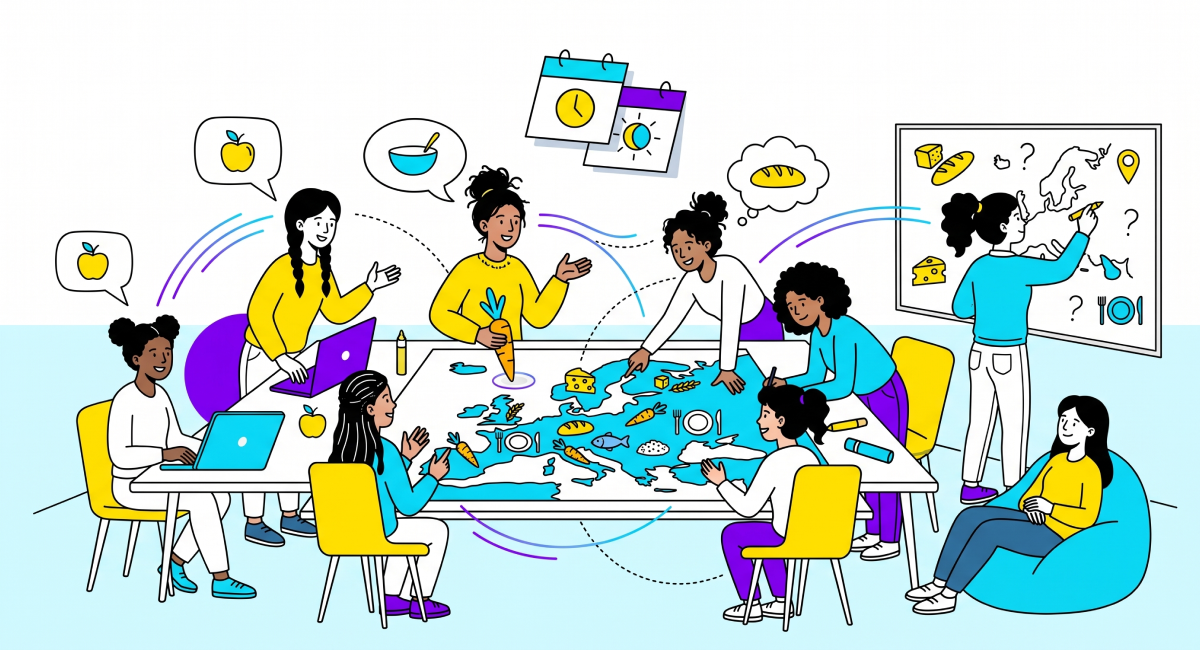
CollectiveUP has been selected to organise Feeding the Future Gent — a two-day hackathon on 20 and 21 November 2026 for forty girls aged 15 to 18, within the European Girls Go STEM programme, on the module Feeding the Future: Tech Solutions for Food Security and Safety. We are delivering it for 28DIGITAL and EIT Food.
What actually happens across the two days
Day one is at ILVO in Melle — the Flanders Research Institute for Agriculture, Fisheries and Food. Not a classroom pretending to be a lab. An actual research institute, with actual researchers, working on actual problems in food security and safety. The participants meet the science where it is done, and take a real challenge away from it.
Day two is at the Mutation Festival in the Wintercircus in Ghent — where the teams build their solutions and pitch them, on a stage, to a public audience.
That second detail is not decoration. There is a measurable difference between presenting to a teacher and presenting to a room of strangers who did not have to come. Standing up in front of a festival crowd and defending an idea you built in a day is the kind of experience that rearranges what a young person believes she is capable of. We have watched it happen often enough to design for it deliberately.
Why "girls only", and why we are not apologetic
The objection arrives on schedule every time: shouldn't this be open to everyone?
Everything should be open to everyone. That is precisely the problem. "Open to everyone" is how you reproduce the existing distribution, because the people who already feel entitled to the room walk into it and the people who do not, do not.
Targeted formats are a correction, not a favour. They exist for exactly as long as the imbalance does. When a fifteen-year-old looks at a hackathon team and sees people like her holding the laptop rather than the notes, the calculation about whether she belongs there changes — and that calculation is made young, quietly, and largely irreversibly.
Food is a particularly good terrain for this. It is concrete, urgent and legible: everyone eats, everyone has an opinion, and the technology behind it runs from soil sensors to supply-chain software to consumer apps. There is no point in the system where a curious teenager cannot find a foothold.
What we are bringing to it
This is the work CollectiveUP does: designing participatory formats that reach the people a programme says it wants to reach, and then actually reaching them. Facilitation that holds a room of forty teenagers without flattening the quiet ones. Partnerships with research institutions and festivals that give young people somewhere real to stand. Evaluation that measures whether it worked rather than whether everyone enjoyed it.
It also sits squarely in a thread that runs through most of our portfolio — Skills+ 3.0 on inclusion in vocational skills, CONIFER on children and young people shaping their own neighbourhoods, FutureEd on rights-centred education. Different funders, different sectors, same conviction: the people affected by a decision should be in the room while it is being made, and they show up with better questions than anyone expects.
Two ways to be part of this
Are you a school, a youth organisation or a parent in East Flanders? Forty places is forty. If you work with girls aged 15 to 18 who would take to a day inside a food research institute and a day building something on a festival stage, get in touch now and we will make sure they hear when registration opens.
Are you an organisation working on food systems, agri-tech, food safety or youth STEM? There is room around an event like this — mentors for the teams, a challenge to put in front of them, a presence on day two. Tell us what you would want to contribute.
One email does either: liliana.carrillo@collectiveup.be
And if you are a programme owner reading this and wondering who could run something similar for you — that is a conversation we are always glad to have.
Feeding the Future Gent is delivered by CollectiveUP BV within the Girls Go STEM programme, on behalf of 28DIGITAL and EIT Food.
#GirlsGoSTEM #WomenInSTEM #FeedingTheFuture #FoodSecurity #Hackathon #YouthEngagement #Ghent #EITFood #Inclusion #STEMEducation #CollectiveUP