What DNA's Third Places teach us about participation


Not home, not work. The places in between, where neighbours meet, make things and argue about what comes next, are what researchers call Third Places. They are also where participation stops being a method and becomes a habit.
This autumn the partners of DNA, a Strategic Topic Group of EIT Culture & Creativity, chose three of these places to study closely. CollectiveUP is the communication partner of DNA, so over the coming months we will share what the pilots teach us. Here is where we start.
Three places, three ways of deciding together
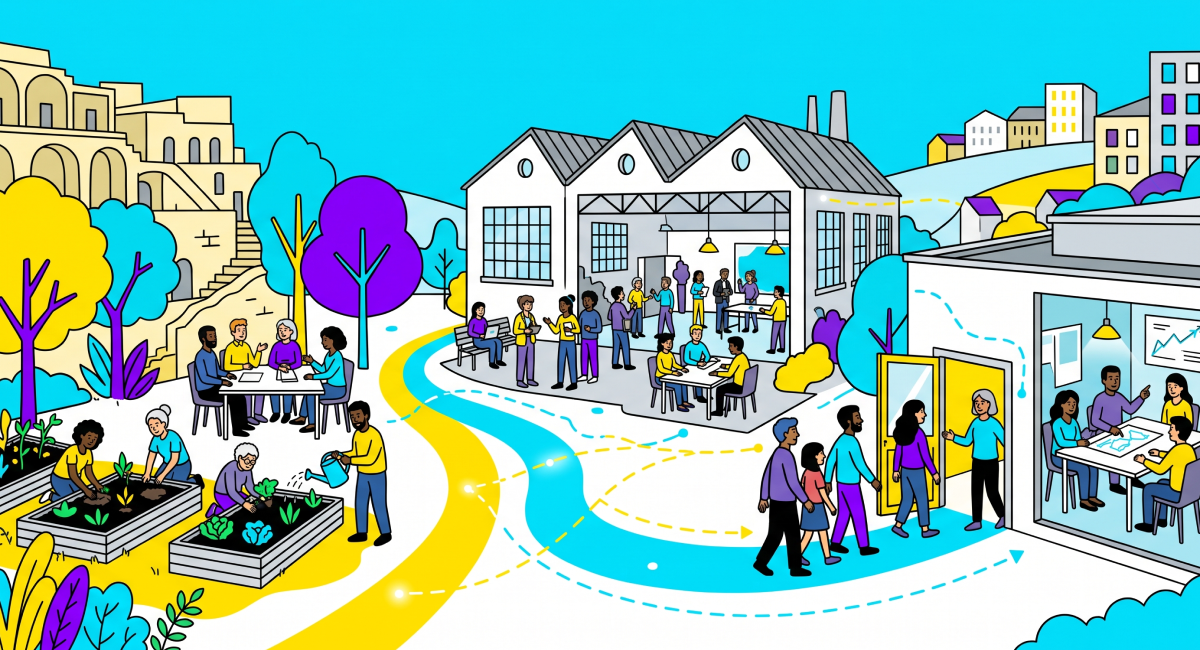
Noi Ortadini Urban Community Gardens, Matera (Italy). Land transformed through regenerative design and community-led action. The garden faces two very current pressures, climate resilience and the loss of urban biodiversity, and answers them with people: the neighbours who plant, water and decide.
Friche Belle de Mai, Marseille (France). A former tobacco factory transformed into a cultural and social hub, run as a social cooperative. Public authorities, residents, entrepreneurs and civil society sit inside the same governance structure. It is one of the clearest European examples of shared ownership of a large place.
The Nowa Huta Real-World Lab (PACESETTERS), Krakow (Poland). A neighbourhood lab that was initiated by institutions and is governed in a participatory way, working on migration pressure and local resilience. It shows that institutions can open the door, as long as residents get a real say once they walk through it.
Why these three?
They differ in almost every way that matters: setting, size, governance and funding. One grew from the ground up, one is a cooperative with many owners, one started inside institutions. That contrast is the point. If we only studied places that look alike, we would learn how one model works. By studying three very different ones, we can ask what makes participation hold in each, and what travels from one context to another.
Three early lessons for anyone who runs a place
- Ownership grows from use. People care for what they shape with their own hands and time. A garden, a hall or a street becomes "ours" when it is used and decided together, not when it is handed over.
- Governance is a design choice. Who sits at the table, who can propose, who can say no: these are design decisions, as concrete as the layout of a building. Friche Belle de Mai shows how a cooperative structure can hold very different interests.
- Institutions can start it; they cannot own it alone. Nowa Huta shows that a city or a university can launch a lab, and that its legitimacy comes from the residents who govern it.
These are first readings from the pilot descriptions, not conclusions. The study will test them with the people who run and use the three places.
What happens next
This week the DNA community meets in Aarhus (19–20 November). Our colleague Esztella Rostási is there for CollectiveUP. Over the coming months we will follow the pilots and publish what we learn, here and on our channels.
Why this matters for your organisation
At CollectiveUP we sell participation: projects, events, methods and tech tools for urban planning, regional planning and strategic thinking in organisations. The three DNA pilots are a reminder of why: participation is the key for great co-creation, and it works best when it is built into how a place is run.
If you run a place, a programme or an organisation and want to make decisions with the people they affect, write to us at com@collectiveup.be.
Thank you
Thank you to MIN4CI, Materahub and Jagiellonian University for bringing these cases forward and opening their communities to the study. Thank you to NTNU, Eötvös Loránd University, FBKW, Artcentrica and Aarhus University ARTS for the careful selection. Thank you to the teams of Noi Ortadini, Friche Belle de Mai and the Nowa Huta Real-World Lab for letting us learn from their work. And thank you to EIT Culture & Creativity for making DNA possible.
STG DNA is an Strategic Topic Group of the EIT Culture & Creativity ecosystem and funded by the EIT Culture & Creativity
#DNA #EITCultureCreativity #ThirdPlaces #NewEuropeanBauhaus #Participation #CollectiveUP