6 rooms in Europe where the next decade of culture gets decided


This month, CollectiveUP joined six of them at once.
Between 1 and 15 September, we start work in six Strategic Topic Groups under EIT Culture & Creativity — the European Institute of Innovation and Technology's knowledge community for the cultural and creative sectors. Strategic Topic Groups are small, fast, focused consortia: eight or nine months, a handful of partners each, and a mandate to turn scattered expertise into something a policymaker can actually use.
Six at once is a lot. So the honest question is why we said yes to all of them — and what we think we are bringing to rooms that are full of universities, film schools and national game industry bodies.
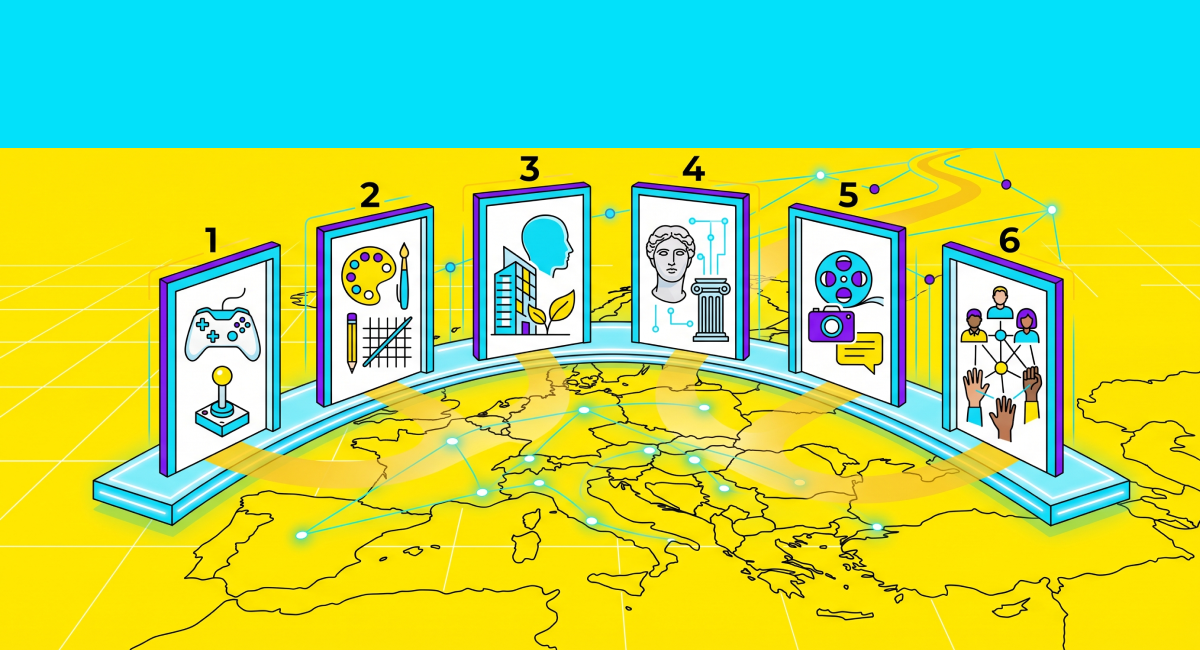
The six, and what each one is for
1️⃣ STG DNA starts 1 September, led from MIN4CI at Université Côte d'Azur. Our role is what the group calls the applied partner: the one that takes research and drags it into contact with reality, through living labs and co-creation workshops. Somebody in every consortium has to ask "yes, but would a real person use this?" That is the job.
2️⃣ STG EDGE starts 1 September, led from the University of Bologna. This is the one we are most directly accountable for: CollectiveUP co-leads, with RISE, the design skillset pilot workshop for cultural and creative sector professionals in Belgium. Not a survey about skills — an actual workshop, with actual Belgian practitioners, testing what a design skillset for this sector should contain. We also contribute to the foresight work co-designing policy briefs for new value chains.
3️⃣ STG Future EGI starts 1 September, coordinated by Neogames Finland, the national body for the Finnish game industry. Its kick-off is on 9 September. The European games industry is one of the continent's most successful creative exports and one of its least understood policy areas — we are here mainly to make sure participation and inclusion questions get asked early rather than retrofitted.
4️⃣ STG NEB Resilience starts 15 September, led from Aarhus University, and runs a series of NEB Resilience Labs — capacity building and co-creation anchored in the New European Bauhaus. Resilience is a word that can mean anything; the group's task is to make it mean something specific enough to fund. We contribute to the Lab series, the cross-pollination work between European learning ecosystems, and the policy co-design.
5️⃣ STG CHARGE starts 15 September, involving the International Centre for Cultural Heritage Protection and Conservation Research, and meets in Aarhus on 3 October, immediately after the CLC North Open Days. Cultural heritage protection is a field where technology is racing ahead of ethics. This STG is coordinated by Fraunhofer-Gesellschaft.
6️⃣ STG Narrative EU starts 1 October, led from Film University Babelsberg KONRAD WOLF. Here we contribute participatory-methods expertise to the Community Storytelling Lab — which develops replicable models for using audiovisual storytelling to address social challenges, run across three sites led by MIN4CI, FBKW and TECNALIA. This is close to home: photovoice and participatory storytelling are methods we have run with citizens, young people and schools for years. The task is to turn our practice into something other organisations can pick up and use.
What we are actually there to do
Look across the six and a pattern shows up. In five of them, our contribution is some version of the same thing: making sure that the people a project is ultimately for are in the room while it is being designed.
That sounds like a soft contribution. It is not. Cultural and creative sector policy has a specific failure mode — it gets written by and for the people already inside the sector, and then nobody can explain why the audience did not turn up. Participation is the correction. Co-creation workshops, living labs, participatory foresight, community storytelling: these are the methods that put a project in contact with the people it claims to serve, early enough to change the design rather than just validate it.
The other thing we bring is stubbornness about the New European Bauhaus principles — beautiful, sustainable, together — appearing in the metrics and not only in the introduction. It is easy to write NEB language into a proposal. It is harder to build it into how success is measured. That is where we tend to be useful, and occasionally annoying.
Why six, and why now
There is a strategic answer and an honest one.
The strategic answer: these six groups touch games, film, design, heritage, urban resilience and research-to-practice. That is close to the full width of the cultural and creative sectors, and being in all of them at once means we see the connections between them — which is exactly the position from which useful policy input comes.
The honest answer: this is how a small organisation earns the right to be in bigger rooms. Strategic Topic Groups are short and demanding, and they put us alongside institutions like Aarhus, Bologna, Babelsberg and Côte d'Azur on genuinely shared work. Consortium leads notice who delivers. That is the flywheel, and we are not shy about it.
It also lands at a good moment. September closes DIGISET after two years of work on the digitalisation of the social economy, and it starts INTouch with eight universities. The six Strategic Topic Groups sit precisely between those two poles — applied social innovation on one side, academic depth on the other.
If your work touches any of these
Two open invitations.
Belgian cultural and creative professionals: the STG EDGE design skillset pilot workshop happens in Belgium and we want the room to be genuinely representative — designers, makers, cultural workers, people running small creative businesses. If that is you, or someone in your network, get in touch and we will send the details when dates are set.
Organisations working on culture, heritage, games, storytelling or the New European Bauhaus: these six groups run until mid-2027, and each of them is a preview of where European funding in this space is heading. If you are planning a proposal in any of these areas, a conversation with us now is more useful than one after the call opens.
And a date for the diary: in October, our Collaboration Lab returns as a quarterly event, co-hosted with Impact Hub Network and built around specific European funding calls — where organisations find their consortium partners against a real deadline. Details shortly.
Either way, one email starts it: liliana.carrillo@collectiveup.be
CollectiveUP participates in these Strategic Topic Groups as a partner of EIT Culture & Creativity, a Knowledge and Innovation Community of the European Institute of Innovation and Technology (EIT), a body of the European Union.
#EITCultureAndCreativity #CulturalAndCreativeSectors #NewEuropeanBauhaus #CoCreation #ParticipatoryDesign #CulturalHeritage #GamesIndustry #Storytelling #CollectiveUP