150 random Europeans meet in Brussels: Why it matters


They were not elected. They did not apply. Nobody lobbied to get them there.
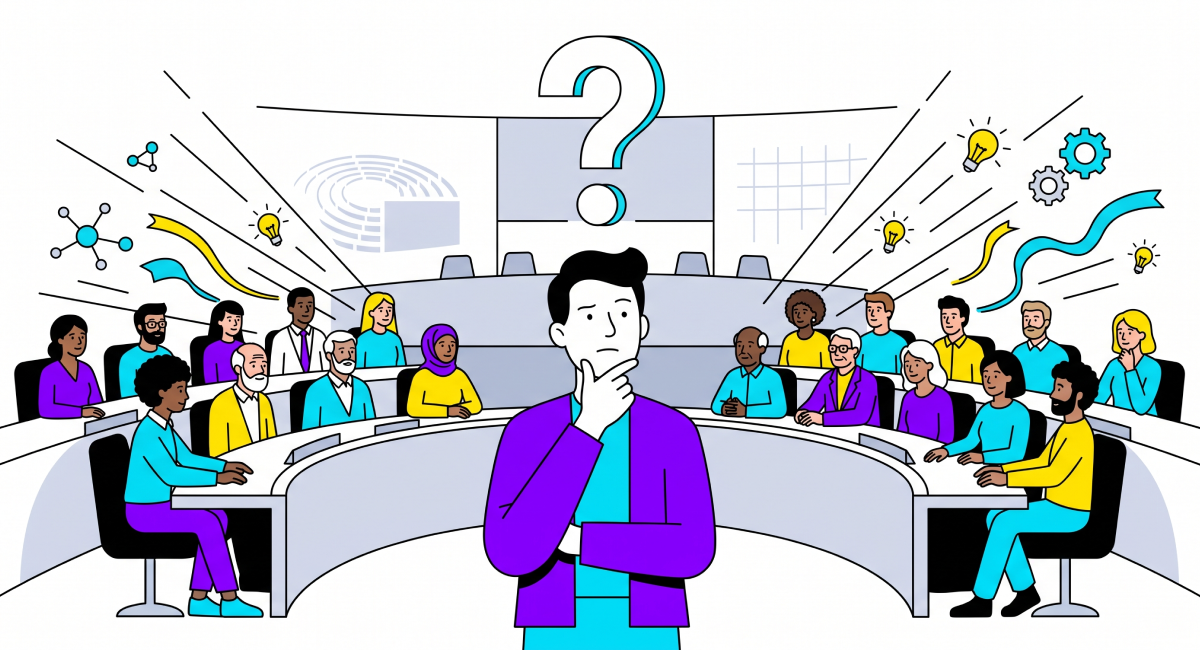
Between Friday 18 and Sunday 20 September, one hundred and fifty people drawn at random from all twenty-seven EU member states sat down in Brussels to spend a weekend on a question most of us only shout about online: what is actually wrong with European democracy, and what would fix it?
This is the first of three sessions of the European Citizens' Panel on democratic resilience, organised by the European Commission. A school student from Yambol. A child psychologist from Plovdiv. A Finnish pensioner, a Portuguese nurse, a German warehouse supervisor — the whole point is that you cannot predict who is in the room, because nobody chose them for their opinions.
We work in citizen participation for a living, and we think this weekend is worth paying attention to even if you will never set foot in the Charlemagne building.
What a citizens' panel actually is
A European Citizens' Panel is not a consultation, a survey or a stakeholder roundtable. It is a deliberative process built on three ingredients that almost never appear together:
- Sortition. 150 people, randomly selected, stratified so the room mirrors Europe's diversity rather than its loudest constituencies.
- Time and information. Participants are briefed by experts, institutions, civil society and academics, and can question all of them. Session one, this weekend, is largely about understanding the problem before anyone proposes anything.
- Facilitated deliberation. Trained moderators run the small groups so that the confident do not crowd out the quiet. This is the unglamorous part, and it is the part that decides whether the output is any good.
European Citizens' Panels have been a permanent feature of EU democracy since the Conference on the Future of Europe. This one runs across three sessions: Brussels in September, online in October, and a final round in November where the working groups turn discussion into concrete proposals, vote on them, and hand a document to the Commission.
The two numbers behind the panel
The panel's own framing tells you why the Commission put democratic resilience on the table in the first place.
45% of EU citizens do not believe that elections in their country are free from interference.
52% say they have personally encountered disinformation or information manipulation at least once a week.
Sit with those for a second. Nearly half of Europeans suspect the foundational act of democracy is compromised, and more than half meet manipulated information as routinely as they check the weather. Those are not media-literacy statistics. They are trust statistics — and trust is not repaired by better communication campaigns. It is repaired by giving people real, visible influence over decisions and then showing them what happened to their input.
Which is precisely what a citizens' panel is a test of.
Do these panels change anything?
The honest answer is: sometimes, and the mechanism matters more than the enthusiasm.
The clearest precedent is the European Citizens' Panel on virtual worlds, whose 23 recommendations fed directly into the Commission's strategy on Web 4.0 and virtual worlds. Earlier panels have covered food waste, learning mobility, intergenerational fairness, and — across March, April and May this year — crisis preparedness. The Commission has committed to follow up on this panel's recommendations, with results expected next year.
The failure mode is equally well documented, and it is not usually the citizens. Panels underperform when the commissioning institution has not decided in advance what it will do with the output, when the mandate is vague enough that any answer can be filed away as "interesting," or when nobody ever goes back to the 150 people to say what their words changed. Deliberation without a feedback loop is expensive theatre.
What this looks like when you shrink it to a street
We spend most of our time running this method at a scale where the stakes are smaller and the consequences are immediate — a neighbourhood, a school, a city district.
In the CONIFER project, we run one of six European civic labs, ours in Ghent, bringing residents and young people into decisions about proximity, walking, cycling and the daily school run. In our education work we use rights-centred and democratic methods to put pupils in real deliberation about the rules that govern their own days. In both cases the pattern repeats with uncanny consistency: the people most affected by a decision are almost never the people filling the comment sections, and they show up with better questions than anyone expected once you build a room where showing up is worth it.
The Commission has also pre-selected CollectiveUP under its framework for citizen participation and deliberative democracy services — the same craft, applied to European-level processes.
Three things that decide whether your participation process is real
If you are commissioning, designing or sitting inside one of these processes, this is what we would push you on:
- Decide what you will do with the output before you start. A participation process with an undefined destination is a consultation wearing better clothes. Write down, in advance, which decisions the output can actually move.
- Design for the people who will not show up on their own. Random selection at EU level, targeted outreach at neighbourhood level, accessibility built in from the first meeting — not retrofitted after someone notices the room is homogeneous.
- Close the loop, publicly. Go back to every participant with what changed, what did not, and why. This single step does more for institutional trust than the deliberation itself.
Work with us
If you are a European institution, a national agency, a city, a school network or a consortium lead who needs participation designed properly — citizens' panels and deliberative formats, civic labs, participatory foresight, photovoice with young people, accessible facilitation — this is our craft and we would like to put it to work with you.
We are also actively looking for consortium partners for upcoming Horizon Europe and Erasmus+ calls where citizen participation, democratic resilience and inclusion are central.
One email, one conversation: liliana.carrillo@collectiveup.be
#CitizenParticipation #DeliberativeDemocracy #EuropeanCitizensPanel #DemocraticResilience #CivicEngagement #ParticipatoryDesign #EUDemocracy #CollectiveUP #HorizonEurope #CivicLabs #CONIFER