


DIGISET releases D5.2: 14 policy recommendations to shape the digital future of Europe's social economy
<p class="p_intro">As DIGISET moves toward its closing phase, the consortium is publishing the evidence-driven policy recommendations that will outlive the project itself.</p>
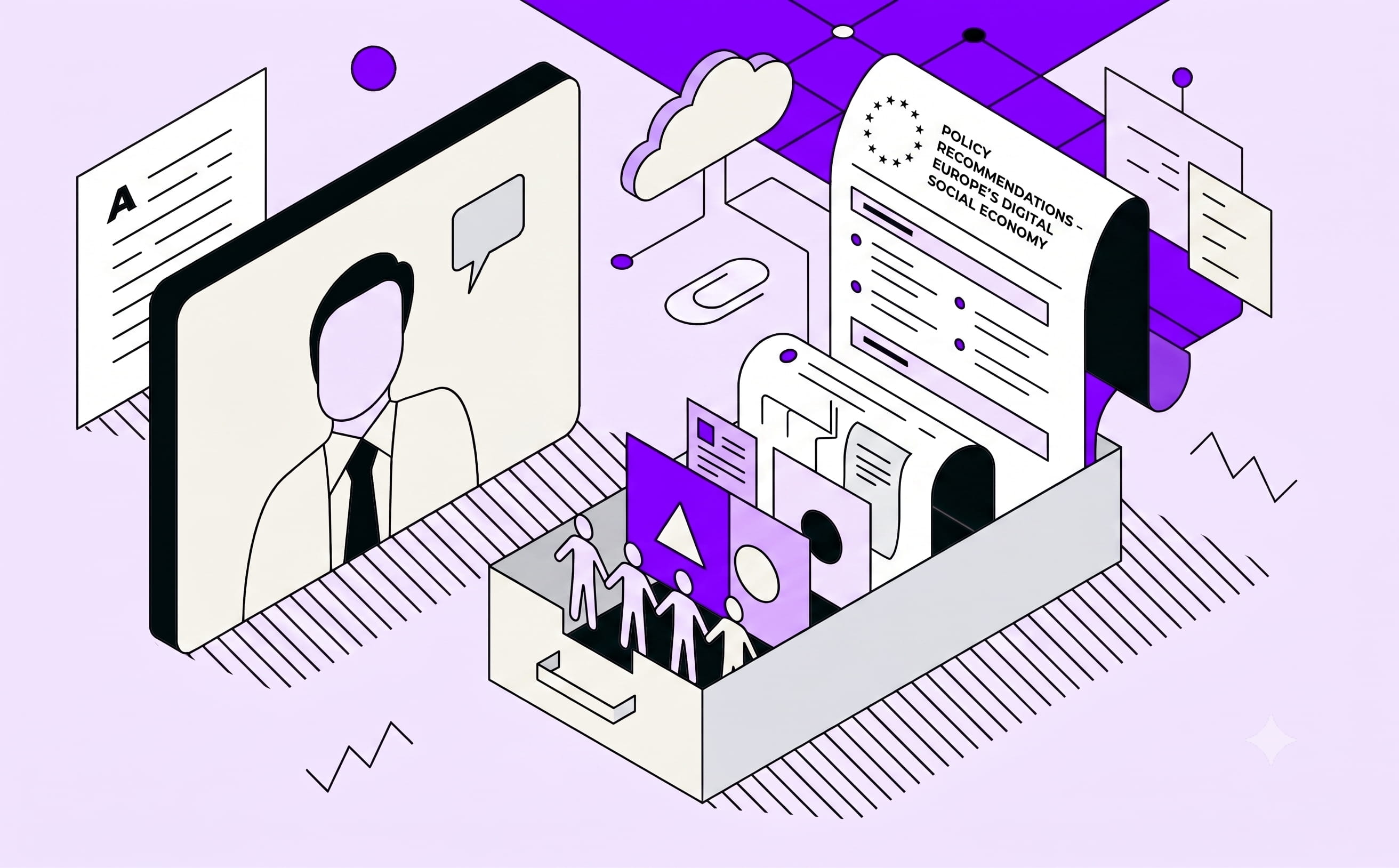
<p class="p_intro">After two years of workshops, transnational events, digital diagnostics, financial support schemes, a 102-organisation needs survey, and a participatory consortium reflection held in Amsterdam on 4 June 2026, DIGISET is proud to release Deliverable D5.2 — Policy Recommendations</p>
<p class="p_desc">Prepared by <strong>Laura Armayones</strong> and <strong>Lluc Segura</strong> (<a href="https://eurecat.org/home/en/"target="_blank" class="link_richtxt">Eurecat</a>) together with <strong>Jeanne Bretécher</strong> (<a href="https://socialgoodaccelerator.eu/"target="_blank" class="link_richtxt">Social Good Accelerator</a>) under Work Package 5 (<strong>Financial Empowerment and Policy and Future Strategy Initiatives</strong>), the 41-page deliverable presents <strong>14 concrete recommendations</strong> for European, national and regional policymakers on how to accelerate — and safeguard — the digital transition of the social economy.</p>
👉 <a href="https://cdn.prod.website-files.com/65b1457e5518485de42e062c/6a5004b35beb69a3a4eb894a_D5.2%20Policy%20Recommendations.pdf" target="_blank" class="link_richtxt" >Read the full deliverable</a>
<h3 class="h3_desc">Why this deliverable matters now</h3>
<p class="p_desc">The European Union has built a solid policy foundation for the digital transition of the social economy: the <a href="https://digital-strategy.ec.europa.eu/en/policies/digital-decade"target="_blank" class="link_richtxt">Digital Decade Policy Programme</a>, the <a href="https://social-economy-gateway.ec.europa.eu/"target="_blank" class="link_richtxt">Social Economy Action Plan (SEAP)</a>, the Transition Pathway for the Proximity and Social Economy Ecosystem, and programmes including ESF+, Horizon Europe, Digital Europe, InvestEU, Erasmus+ and the Single Market Programme (COSME) all contribute significant capacity.</p>
<p class="p_desc"><strong>Yet DIGISET's ground evidence tells a different story.</strong> Many social economy organisations still cannot translate these opportunities into practice. Limited organisational capacity, fragmented access to funding, digital skills gaps, cybersecurity concerns, and the shortage of tailored support continue to constrain digital uptake — particularly among smaller organisations.</p>
<p class="p_desc">D5.2 was designed to close that gap. It is grounded in three complementary evidence streams:</p>
<p class="p_desc">1. <strong>A systematic desk review</strong> of EU and regional/local policy documents and funding instruments</p>
<p class="p_desc">2. <strong>DIGISET's own field evidence</strong>, including WP1's needs assessment with <strong>102 social economy organisations</strong> and cumulative feedback from every workshop and event we hosted</p>
<p class="p_desc">3. <strong>A structured participatory workshop</strong> with all consortium partners on 4 June 2026 in Amsterdam, using a "time-travel" reflection exercise to consolidate lessons learnt</p>
<h3 class="h3_desc">What social SMEs and SEOs told us</h3>
<p class="p_desc">Two years of dialogue produced a strikingly consistent picture. The needs assessment conducted with 102 social SMEs identified six priority areas:</p>
<p class="p_desc">- <strong>Digital infrastructure and technology adoption — 38.0%</strong> (by far the top-cited need)</p><p class="p_desc">- <strong>Business process transformation and optimisation — 18.5%</strong></p>
<p class="p_desc">- <strong>Digital strategy and ecosystem support — 13.0%</strong></p><p class="p_desc">- <strong>Financial support and strategic resources — 10.9%</strong></p>
<p class="p_desc">- <strong>Digital skills, competences and talent development — 9.8%</strong></p>
<p class="p_desc">- <strong>Cybersecurity, data privacy and risk management — 9.8%</strong></p>
<p class="p_desc">On AI, social SMEs expressed a <strong>mixed but genuinely open attitude</strong>. They see clear potential to reduce administrative burden, free up capacity for their social mission, and support tasks like tender research, translation, planning, and reporting. They are also worried — about data protection, GDPR compliance, bias, dependency on commercial platforms, rising subscription costs, environmental impact, and the risk that AI could replace or de-value certain roles.</p>
<p class="p_desc"><strong>Social Enabling Organisations (SEOs)</strong> — the networks, federations and umbrella structures that connect social SMEs to the wider ecosystem — expressed different but complementary needs: ecosystem-level support, capacity building, shared spaces for reflection, and access to trusted, values-aligned AI guidance. Their message on AI was cautious but constructive: AI should support people, not replace them.</p>
<h3 class="h3_desc">The 14 recommendations, at a glance</h3>
<p class="p_desc">The recommendations are organised across four thematic clusters. Each is fully specified in the deliverable, with the responsible governance level (EU, national, regional or local) and the expected impact.</p>
<h4 class="h4_desc">Governance & voice for the social economy</h4>
<p class="p_desc">1. <strong>Harmonise definitions and classifications</strong> of social economy actors across the EU, so that eligibility rules for EU-funded programmes stop varying between Member States.</p>
<p class="p_desc">2. <strong>Ensure structured representation of the social economy</strong> in EU digital policymaking — including a dedicated focal point for the Digital Social Economy at DG CNECT, working with DG EMPL, and systematic inclusion of SE and civil-society voices in expert groups and advisory bodies.</p>
<p class="p_desc">3. <strong>Foster participatory and co-creative approaches</strong> to policy design at every level — DIGISET's own experience showed that co-designed activities generated significantly higher engagement than top-down formats.</p>
<p class="p_desc">4. <strong>Strengthen synergies and knowledge exchange among EU-funded projects</strong> through peer-learning, collaborative platforms and coordination mechanisms — reducing the competition dynamics that overlapping KPIs currently create.</p>
<h4 class="h4_desc">Intermediaries and tailored support pathways</h4>
<p class="p_desc">5. <strong>Establish differentiated digital support pathways based on digital maturity</strong> — moving beyond one-size-fits-all approaches with introductory <em>and</em> advanced tracks, plus common assessment tools.</p>
<p class="p_desc">6. <strong>Strengthen the role of SEOs as recognised, funded digital intermediaries</strong> — including strategic alignment with the Open Internet Stack, EuroStack and the Digital Commons EDIC as pillars of a democratic, sovereign European digital ecosystem.</p>
<p class="p_desc">7. <strong>Strengthen collaboration between European Digital Innovation Hubs (EDIHs) and social economy organisations</strong> — for experimentation, co-financing and continuous expert mentoring.</p>
<p class="p_desc">8. <strong>Support social SMEs in identifying relevant and realistic digital and AI use cases</strong> — needs diagnosis, use-case mapping, prioritisation tools, and peer examples. Many organisations don't reject digitalisation; they simply don't know where to start.</p>
<h4 class="h4_desc">AI, data and digital commons</h4>
<p class="p_desc">9. <strong>Develop accessible, modular and SSE-specific AI literacy resources</strong> that address both the opportunities and the ethical risks of AI adoption — tailored to the values and capacities of social economy actors.</p>
<p class="p_desc">10. <strong>Support the development, maintenance and adoption of Digital Commons for the Social Economy</strong> — with dedicated financial instruments for open-source software, shared digital infrastructures, interoperable tools and community-governed digital services. This is where digital sovereignty gets real.</p>
<p class="p_desc">11. <strong>Raise awareness of the environmental and social impacts of AI adoption</strong> — energy consumption, working conditions, platform dependency and dehumanisation risks. Technology adoption in the social economy must remain aligned with sustainability and inclusion.</p>
<p class="p_desc">12. <strong>Develop a Data and AI Governance Framework for the Social Economy</strong> — practical guidance on ethical AI adoption, transparency, privacy, human oversight, bias mitigation and responsible data sharing.</p>
<h4 class="h4_desc">Sustainable funding and cyber-resilience</h4>
<p class="p_desc">13. <strong>Integrate digital transformation support into long-term, stable funding frameworks</strong> — moving beyond project-based logic toward sustained ecosystem investment. The knowledge, trust and infrastructure built during projects should not evaporate when the funding does.</p>
<p class="p_desc">14. <strong>Strengthen mutualised cybersecurity support</strong> for social economy organisations — particularly micro and small entities managing sensitive data or delivering essential services. Shared cybersecurity commons, inspired by models like Cyber for Good, would let small organisations access specialised expertise they could never afford alone.</p>
<h3 class="h3_desc">Lessons that shaped the recommendations</h3>
<p class="p_desc">Beyond policy analysis, D5.2 documents the practical lessons the consortium accumulated across every workshop, event and partner interaction. Three stand out:</p>
<p class="p_desc">- <strong>Engagement is one-to-one, personal and local.</strong> Social SMEs engage around concrete business problems, not around the abstract topic of "digitalisation." Personal emails, phone calls, direct trust-based outreach and local-language communication consistently outperformed generic mass communication.</p>
<p class="p_desc">- <strong>Co-design beats delivery.</strong> Workshops that let participants work together on concrete challenges — rather than only receiving expert-led content — supported peer learning, ownership and follow-through. Practical, ready-to-go templates and modular short formats worked far better than long lectures.</p>
<p class="p_desc">- <strong>SEOs are the ecosystem's connective tissue.</strong> Engaging Social Enabling Organisations first — as trusted federations, networks and umbrella structures — was the single most effective strategy for reaching social SMEs.</p>
<h3 class="h3_desc">What comes next</h3>
<p class="p_desc">DIGISET formally closes in <strong>August 2026</strong>. But the questions D5.2 raises — how to build sovereign, ethical, sustainable digital foundations for Europe's social economy — do not close with the project.</p>
<p class="p_desc">The consortium is already carrying the D5.2 evidence-to-action chain into the design of <strong>DIGISET+</strong>, a Cooperation Partnership proposal under <strong>Erasmus+ KA220</strong></p>
<p class="p_desc">We are also actively engaging with EU policymakers, sister projects and Member State authorities to translate these 14 recommendations into concrete actions across the 2026–2027 policy cycle.</p>
<h3 class="h3_desc">Get involved</h3>
<p class="p_desc"><strong>📄 Read the full deliverable →</strong><a href="https://cdn.prod.website-files.com/65b1457e5518485de42e062c/6a5004b35beb69a3a4eb894a_D5.2%20Policy%20Recommendations.pdf" target="_blank" class="link_richtxt" >here</a></p>
<p class="p_desc"><strong>💬 Join the DIGISET Discord community →</strong><a href="https://discord.gg/DzfrXtAc" target="_blank" class="link_richtxt">https://discord.gg/DzfrXtAc</a></p><p class="p_desc">An open space for social SMEs, SEOs, EU project officers, sister-project teams and policymakers to keep the conversation going long after the project closes.</p>
<p class="p_desc"><strong>🤝 Partner with the DIGISET consortium</strong> on upcoming EU calls — Horizon Europe, COSME, Erasmus+ and DIGITAL — at the intersection of social economy, digital sovereignty, ethical AI, inclusive design and cybersecurity.</p><p class="p_desc">Reach out via: <a href="mailto:cosmedigiset@gmail.com" target="_blank" class="link_richtxt">cosmedigiset@gmail.com</a></p>
<p class="p_desc">---</p><p class="p_desc"><strong>About the deliverable</strong></p>
<p class="p_desc">Deliverable D5.2 — Policy Recommendations was produced under Work Package 5 (<em>Financial Empowerment and Policy and Future Strategy Initiatives</em>), Tasks 5.3 and 5.4. Authors: Laura Armayones (Eurecat), Lluc Segura (Eurecat), Jeanne Bretécher (Social Good Accelerator). Published June 2026.</p>
<p class="p_desc"><strong>About DIGISET</strong></p>
<p class="p_desc">DIGISET is co-funded by the European Union under the <strong>Single Market Programme (SMP-COSME)</strong>. The consortium brings together <strong><a href="https://www.collectiveup.be/" target="_blank" class="link_richtxt">CollectiveUP</a> (Belgium, coordinator)</strong>, <strong><a href="https://socialgoodaccelerator.eu/" target="_blank" class="link_richtxt">Social Good Accelerator</a> (France)</strong>, <strong><a href="https://ihworld.com/" target="_blank" class="link_richtxt">Impact Hub</a></strong>, <strong><a href="https://www.amsterdam.nl/en/" target="_blank" class="link_richtxt">City of Amsterdam</a> (Netherlands)</strong>, <strong><a href="https://eurecat.org/home/en/" target="_blank" class="link_richtxt">Eurecat</a> (Spain)</strong>, <strong><a href="https://www.clujit.ro/" target="_blank" class="link_richtxt">Cluj IT</a> (Romania)</strong>, <strong><a href="https://www.ulb.be/en" target="_blank" class="link_richtxt">ULB — Université Libre de Bruxelles</a> (Belgium)</strong> and <strong><a href="https://www.fari.brussels/" target="_blank" class="link_richtxt">FARI Brussels</a> (Belgium)</strong>.</p>
<p class="p_desc"><em>Funded by the European Union. Views and opinions expressed are however those of the author(s) only and do not necessarily reflect those of the European Union or the European Innovation Council and SMEs Executive Agency (EISMEA). Neither the European Union nor the granting authority can be held responsible for them.</em></p>


Latest events & news


How a decade of technological growth has transformed small and medium-sized businesses
Over the past ten years, technology has evolved at an unprecedented pace...


DIGISET releases D5.2: 14 policy recommendations to shape the digital future of Europe's social economy
As DIGISET moves toward its closing phase, the consortium is publishing the evidence-driven policy...

